Journal
In Pursuit of Visual Elegance — The Engineering Behind MUKU’s Meticulously Refined Form

Interview with Okamura Team
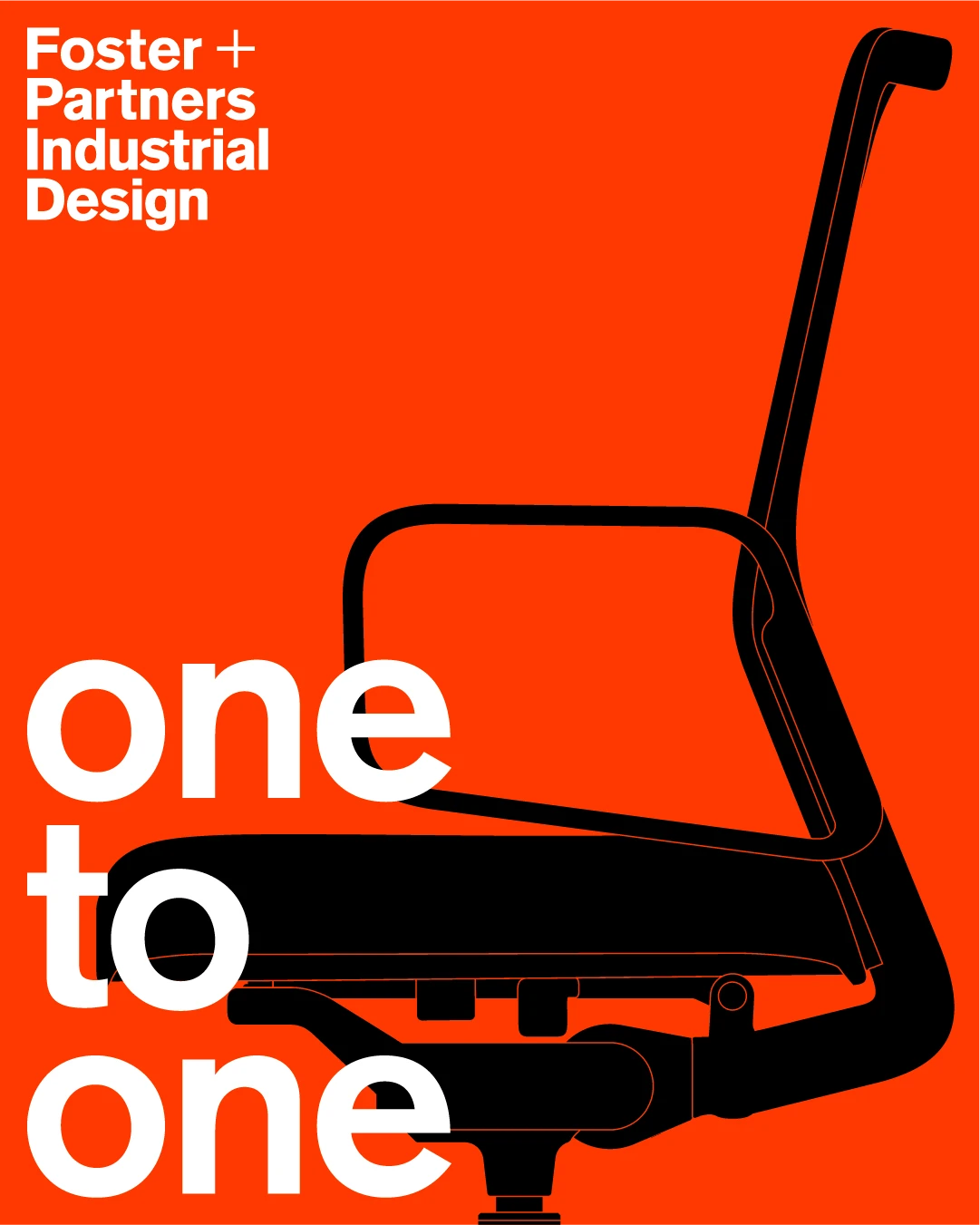
Beneath MUKU’s quiet, light presence lies an extensive process of trial and error — one driven by the challenge of combining task seating performance and safety with sustainability. Looking back on over two years of close collaboration with Foster + Partners Industrial Design, Yoichiro Oda, who led the project from the Product Development Department, and Alexander Hurford, designer in the Work Furniture Design Department of OKAMURA, share their perspective.
A chair equally driven by design and engineering
— What was the biggest challenge in developing MUKU?
ODA: Even before we addressed engineering or design, the project called for an exceptionally high level of communication. Foster + Partners Industrial Design doesn’t draw a line between their responsibilities and the manufacturer’s. When it comes to the engineering side, they want to delve into and make sure they understand every technical detail. Right from the start, we brought them into every facet of the process, sharing information on everything from mass production and assembly to final packaging.
That said, when it comes to the fundamental performance required of task seating, we at Okamura can bring decades of accumulated expertise to the table. Hence we took a proactive role in proposing solutions — particularly for ergonomics, seating comfort, operability, and safety. Rather than simply executing the proposed design, it felt like a true co-creation, with Okamura offering our own perspective on how a chair ought to be as we built it together.
HURFORD: As a designer at Okamura, my own focus was on how to bridge the vision with our engineering and manufacturing capabilities. When it comes to task seating, it isn’t just about designing its exterior. You have to bring everything together into a single, functional product — the seat height, cushion comfort, reclining mechanism, structural strength, stability, and safety, along with all the internal mechanisms that make it work.
Adjusting even a single dimension creates a ripple effect across the entire chair, altering its centre of gravity, overall stability, and recline behaviour. Receiving our partner’s vision, refining the design on Okamura’s side, and bridging that with practical engineering was where my responsibility lay, and it was the biggest challenge I faced.

Reimagining the underlying mechanics for a quiet exterior
— What were your initial impressions when you first saw the proposed design?
ODA: Rather than thinking it looked difficult to achieve, my honest impression was that it was ‘incomplete’ — the components typically essential for a task chair were missing. That’s how pared-back the silhouette was. Crucial details, such as joining the components or accommodating the essential mechanisms, were left completely up in the air.
So, rather than just tacking on the necessary components, we asked ourselves how we could preserve the intended simplicity while still delivering a fully functional task chair. We ended up redesigning nearly every single component that powers the chair’s mechanisms. Instead of encasing and hiding those mechanisms behind outer covers, we overhauled the internal component layout from the ground up to keep the structure itself inherently simple while maintaining all the required functionality.
HURFORD: What struck me was their mindset: rather than hiding the mechanics of the task chair, they said, ‘We can expose them — but if they’re on display, let’s make them beautiful.’ Their approach to surfaces was especially fascinating. Typically, you create smooth surfaces by applying a radius along the junction where two perpendicular planes meet. Instead, they conceived the entire form as a single, continuous surface. Instead of tweaking edge radii, they consistently treated the geometry as an integrated whole.
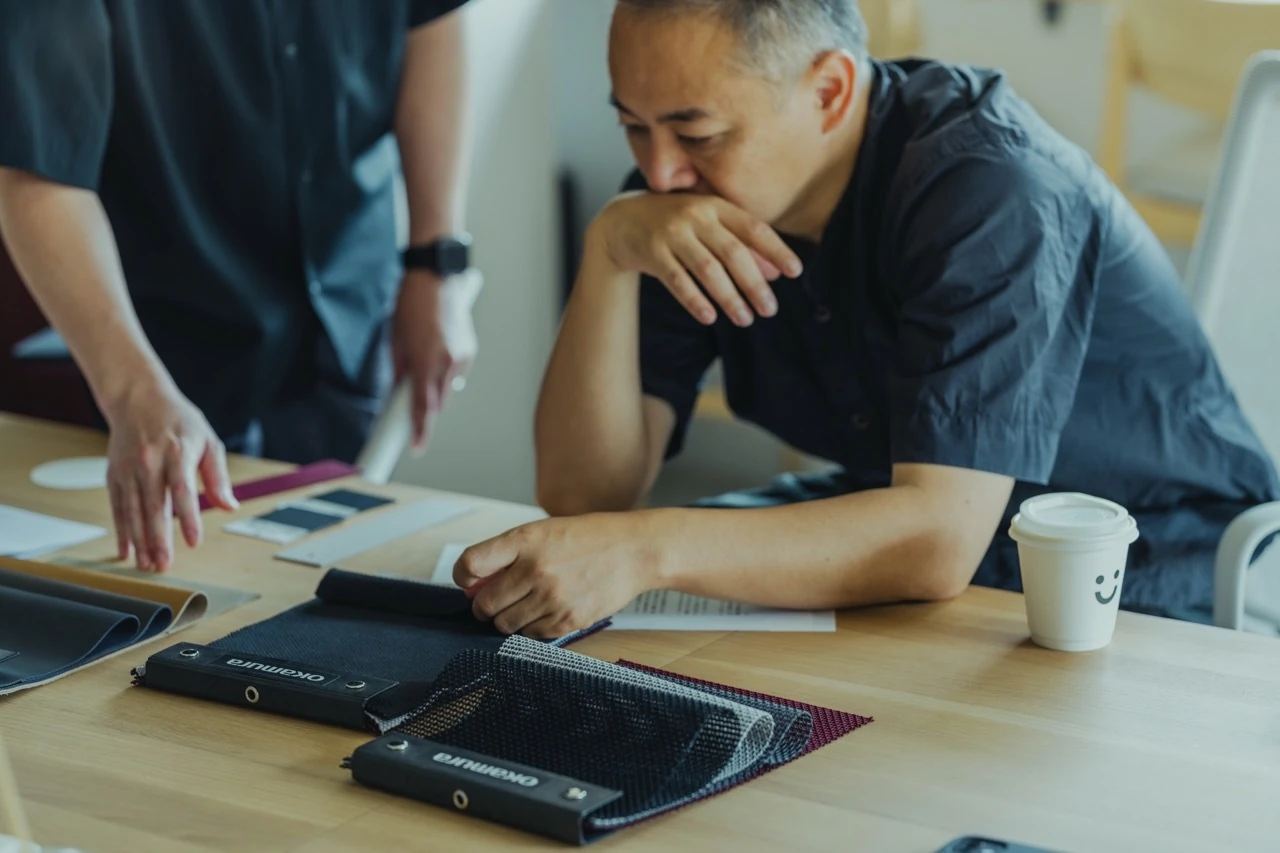
ODA: That approach eliminates visual noise, but it also means that even a microscopic tweak requires reconstructing the entire geometry from scratch. We refined the shape using 3D-printed mockups, constantly evaluating tactile feedback and the way light reflected off the surfaces. We also spent an intensive amount of time adjusting fabrics and colour palettes, even executing fundamental resets late in the process when the final vision was already coming into focus.

Balancing performance, safety, and sustainability
— How did you balance functional requirements and safety required of task seating with the overall design?
HURFORD: We took the lead on ergonomics and seating comfort, relying on Okamura’s built-up know-how in task seating. With MUKU, we designed around the essential goal of supporting the body comfortably — meticulously engineering the cushion for long hours of use, seat height and depth, recline, and lumbar support.
Task seating design is like a puzzle — adjusting one element inevitably affects another. Moving the seat forward shifts the center of gravity, and increasing seat height makes stability harder to guarantee. Furthermore, we had to accommodate lower seat heights for use in Japan and higher ones for international markets, ensuring safety and stability at every position within that range.
The lumbar support was especially tricky in terms of comfort. Mesh and upholstered backrests conform to the body differently, so we had to tune the support feel individually for each, testing and refining prototypes until late in development. At the same time, we focused on housing these mechanisms compactly to preserve MUKU’s light aesthetic. The key was avoiding a disjointed approach — form, mechanics, and comfort had to be resolved together as one cohesive design.
ODA: Sustainability was equally central to our mission from day one. Recycled materials account for roughly 45% of MUKU’s total weight, including REAMIDE — a recycled nylon yarn made from reclaimed Japanese fishing nets — and Re:net, a proprietary knit fabric crafted with recycled PET threads. Moreover, by designing the chair for intuitive disassembly and material separation, we achieved a recyclability rate of approximately 95%.
The core engineering hurdle was reconciling two opposing demands: creating a unified, highly durable product that withstands rigorous daily use, while ensuring it can be effortlessly broken down into raw materials at the end of its lifecycle — all without compromising structural integrity or design aesthetic.
HURFORD: Sustainability is often treated as a secondary feature or an added bonus, but with MUKU, it was embedded as a fundamental pillar of our design process from the very beginning.

A rich, dynamic synthesis of expertise
— Looking back on this collaboration, what key experiences or insights did you take away from the experience?
ODA: Above all, it was our commitment to sustained dialogue right up to the very end. Foster + Partners Industrial Design didn’t simply hand over a design sketch and consider their job done. They continued to iterate and think through problems alongside us every step of the way. On our side, we went beyond merely fulfilling their requirements, proactively offering Okamura’s expertise on the essential performance and functionality a task chair needs. It was a deeply rewarding experience where both sides brought their specialised expertise to the table while maintaining complete respect for each other’s domain. Because of that rigour, I truly feel we created something exceptional.
HURFORD: While I’m naturally thrilled to see the finished product, what moves me most is seeing this entire two-and-a-half-year effort come together and finally reach the light of day. Foster + Partners Industrial Design pays meticulous attention to surface texture, light reflection, and material joints. Meanwhile, Okamura brings decades of know-how in task seating, spanning ergonomics, seating comfort, complex mechanics, safety, and mass production.
Anyone looking at MUKU’s sleek profile would never guess how intricate the development journey was. But making that simplicity possible required a vast amount of specialised knowledge from both the design and engineering sides. This chair is the culmination of bringing together both Foster + Partners Industrial Design’s design concepts and Okamura’s long-standing seating technology.